The fragmented companion: what three apps cost your world
Chat in one app, images in another, lore in a third document nobody has opened since Tuesday. The friction is not the annoying part — the forgetting is.
A familiar evening
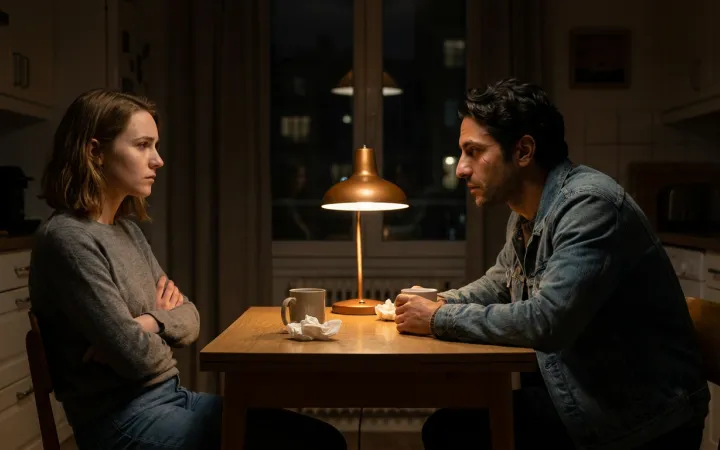
You write a scene in a chat app. It is good — she finally says the thing she has been circling for a week.
You want to see it. So you open an image generator, and now you are a translator: describing her face from memory, adding the room, the light, the time of day, hoping it comes out looking like the same woman as last time. Two or three tries later you have something close, and you save it to a folder with a name you will not understand in a month.
Then you remember the detail about her brother, and you open the document where you keep the lore, and you find it is four scenes out of date, because updating it has never once been the most interesting thing available to do.
None of this is hard. It is just constant, and it is all being done by you.
The gap is where the story leaks out
The cost is not the clicking. It is that each tool starts from nothing.
- The image generator has no story. It cannot know she is exhausted, that it is raining, that the last scene ended badly — unless you type it, every time.
- The chat has no images. It cannot refer to what she looked like, because it never saw it.
- The lore file has no enforcement. Nothing stops the story from contradicting it, so it becomes a record of intentions rather than of facts.
- Nothing accumulates. Three months of good scenes leave you with a chat log, a folder of images and a stale document, and no way to move between them.
In projectDigo the scene, its image and its consequences are one thing. Your world carries itself.
Founder, projectDigo
What sharing state actually changes
This is the bet projectDigo makes: one system writes the scene and renders it, so the render starts from the scene you just played.
The practical differences are small and they compound:
- The image shows the very scene you just played.
- Characters keep their faces, because their references live inside the world itself.
- The lore writes itself as the story establishes it, and every later scene draws on it.
- Your history has one address. The scene, its image, and what it changed are the same object.
The honest counterpoint
Assembling your own stack has a real advantage: you pick the best tool for each job and swap any of them the week something better appears. An integrated system asks you to accept its choices.
The trade is straightforward. You give up some control at each step, and you get a world that holds together without you carrying it between tools. For a one-off image, the stack wins. For a story you intend to still be inside in three months, carrying it yourself is the thing that eventually stops.
Questions we get
Can I bring in characters or worlds I already have?
projectDigo is a curated catalogue rather than a builder: selected stories with a cast of AI actors, each built and approved in-house — worked-out histories, real ties, one true face. You choose what to play, and every session of it opens as its own parallel reality, so even the same story never starts twice the same.
What if I want a specific image model?
Several are available and can be chosen per story. The trade-off is real: an integrated system offers a curated set rather than everything that exists.
Can I get my content out?
There is a data export: your scenes, your generated media and your characters, as files you keep. It is a copy of your material rather than an interchange format — there is no import, so it will not rebuild a playable story anywhere. What it guarantees is that the writing and the images are yours to keep.