Lifelike, consistent, and nothing else: how projectDigo pictures a story
Keeping a face is quickly becoming something every serious tool can do. The commitment that matters now is what you keep: one lifelike register, held absolutely, in images that follow the story.
The picture follows the story
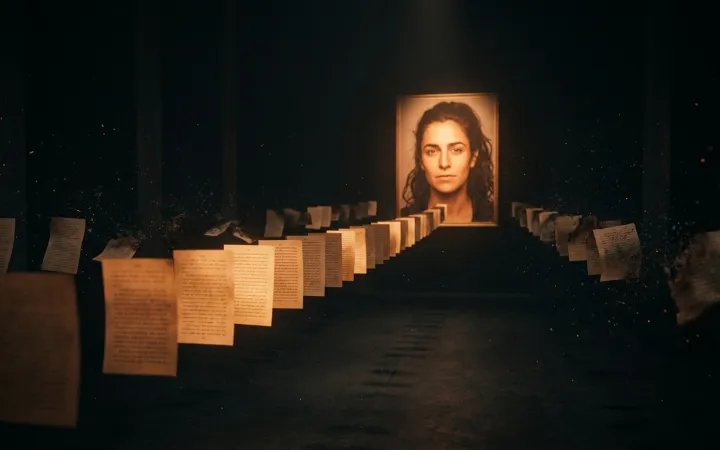
In projectDigo, a scene is written before it is seen. The image arrives after the words, rendered from the scene that already exists — the hour, the weather, who is in the room, what the moment just did to them.
That order is a conviction, not an implementation detail. The picture is testimony: a still from a film that is already running, showing you the scene you just played. A world where the image came first would have it backwards — the story would end up illustrating the picture, and the picture knows nothing.
Everything else this article says rests on that: because the image serves the scene, the one thing it must never do is show you a stranger in it.
Why identical prompts give you different people
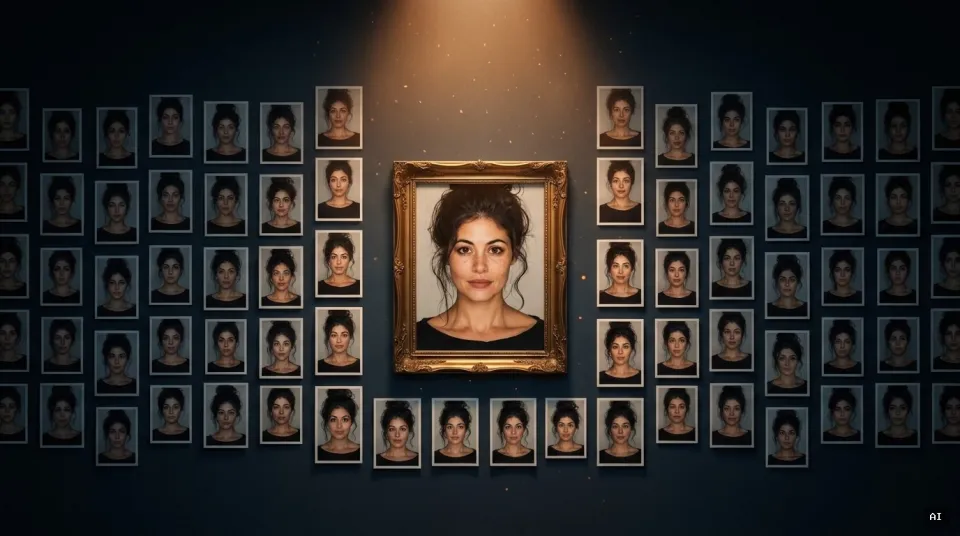
Why do generated characters change face between images at all? Because a prompt is a description of a category. “Woman in her early thirties, dark hair, sharp cheekbones, tired eyes” narrows the space of possible faces enormously — and still leaves millions of them. Each generation samples a new point in that space: you are not asking for her again, you are asking for someone who matches her description again.
Everything else that changes between two scenes makes it worse. Different lighting reshapes a face. A different angle changes which features dominate. A different expression pulls the mouth and eyes somewhere new. All of these are things a story needs to change, so the very variation that makes a scene worth drawing is what pulls an unanchored identity apart. That is why re-using the same prompt was never the fix, in any tool — and why the industry is converging on reference anchoring instead.
Consistency is becoming the entry ticket
Let us be straight about the market: keeping a character's face is getting easier everywhere. Reference-anchored generation is arriving across the industry at once, and within a product cycle it will be standard equipment — a tool that loses the face between two images will simply read as behind.
So "our characters stay consistent" tells you less every month. The interesting question has moved: not whether a product can keep a face, but what it commits to keeping — and how far it is willing to hold that commitment when the story gets long.
One register, held absolutely
projectDigo's commitment is narrow and total: every world is pictured in a single register — lifelike, cinematic realism. There is no style menu, no semi-anime variant, no register-switching mid-story. One world, one light, one truth about how a person looks.
And the people who carry that truth are best understood as actors. projectDigo's characters are a repertory company: each one has a core identity — a face, a bearing, a base personality — settled before they ever appear in a story. Their look is generated, reviewed and approved in-house, and that approved image is the source of truth for their appearance from then on, in every scene, in every world they play in.
Like screen actors, they are not used up by one film. The same actor can carry different roles in different worlds — a different name, a different life, different stakes — and you recognise them instantly, the way you recognise an actor across a career. Absolute consistency is what makes that recognition possible: a scene from the first evening and a scene from a month later are the same person on two different days.
We run a repertory company. Real actors keep their face from film to film, and so do ours: one face, many worlds - and never the same evening twice.
Founder, projectDigo
Realism is the hard mode — and the point
Choosing lifelike as the only register is the demanding path, and that is precisely why it is worth choosing.
Stylization forgives. A slightly-off anime face still reads as the same character, because the style itself absorbs the variance. Photorealism forgives nothing: a human face that is slightly wrong is not a variation, it is a different person, and a reader recognises that in a fraction of a second — before they have read a single word of the scene.
Committing to realism therefore forces the consistency to be absolute. There is no style to hide behind. And it sharpens what change means: when appearance is stable, a real change — a haircut, a scar, an exhausted face after a hard night — reads as story, because it is. It happened, and the picture shows it.
The same actors, never the same evening
The cast is fixed; the evenings are not. projectDigo is a curated catalogue — selected stories, a selected company of AI actors — the way a great streaming catalogue is curated rather than user-assembled. Nothing about a character is customised by hand before you play: the spine is given, the face is given, the relationships are given.
What is never given twice is the performance. Every session opens as its own parallel reality: the fine details of the world are set fresh at the start, so no two playthroughs of the same story begin identically — and they only diverge from there. Replaying a story is not rewatching a film; it is the same company staging the same play on a different night, and the night is genuinely different.
That pairing is deliberate. The actors are absolute so you always know who is in front of you; the performance is unrepeatable so there is always a reason to come back.
What this buys a long story
A single lifelike register, held absolutely, pays the story back in three ways.
Recognition is instant. In a scene with two characters you see who is who before the caption could tell you — the way you recognise people in a photograph of your own life.
Time accumulates. Thirty scenes with one face feel like a month with a person. The images become an album of somewhere you have been, not a gallery of illustrations on a theme.
Change carries meaning. Because the world always looks like itself, what the story alters stands out as an event. The picture is not just consistent with the past — it is evidence that the story has one.
Questions we get
Why do AI-generated characters change face from one image to the next?
Because a text prompt describes a category of faces, and every generation samples a new face from that category. Add the changes a story genuinely needs — light, angle, expression — and the identity drifts further. The industry answer, in projectDigo and increasingly elsewhere, is anchoring: generation starts from an approved image of the specific person rather than from a description that millions of faces could match.
Does projectDigo support anime or stylized art styles?
No. projectDigo renders one register — lifelike, cinematic realism — and puts everything into doing it absolutely. The single committed aesthetic is part of why a long story here stays believable: the world always looks like itself, scene after scene, month after month.
Does the image come before or after the writing?
After, always. The scene is written first, and the image is rendered from the scene that already exists — so it shows what actually happened, in the place and light and state the story established, rather than a generic illustration of the topic.
Can a character's appearance change over a long story?
Yes — through the story. A haircut, a change of clothes, an injury or a hard night show up because the story caused them. Identity holds underneath, which is exactly what makes those changes legible as events rather than noise.
How does a character get their one true face?
Before a character ever appears in a story, their look is settled: candidates are generated, reviewed, and one is approved as truly them. That approved image is the source of truth for every scene after — which is why the person you meet in scene one is the person you see in scene three hundred.
Can I customise a character or import my own?
projectDigo is a curated catalogue: selected stories, a repertory cast of AI actors, each built and approved in-house. You choose what to play, the way you choose from a film catalogue — and the depth of that preparation is exactly what a quick customisation form could never produce.
If I replay a story, do I get the same thing?
No two playthroughs begin the same. Every session opens as its own parallel reality — the fine details of the world are set fresh at the start — and everything that happens builds on that. Same actors, same stage, a genuinely different evening.